
What Is Hybrid Publishing? A Guide for Industry Leaders
For many professionals, writing a book becomes the catalyst for the next stage of their career. Maybe you have spent a decade or more building your business, honing your expertise, and driving change in your field. Now, you have a sense that it’s time to amplify that impact. A book is the natural next step—a way to solidify your legacy, expand your influence, and shape the conversation in your industry.
Navigating the publishing industry can feel complex, especially when your professional reputation is attached to the final product. You need a path that respects your time, honors your expertise, and delivers a publication-ready manuscript.
This brings many thought leaders to explore hybrid publishing. A well-executed hybrid publishing experience combines the rigorous editorial and production standards of traditional publishing with the greater creative control and higher royalties of self-publishing. It positions you to reach your audience effectively while maintaining ownership over your strategic vision.
Understanding the Hybrid Model
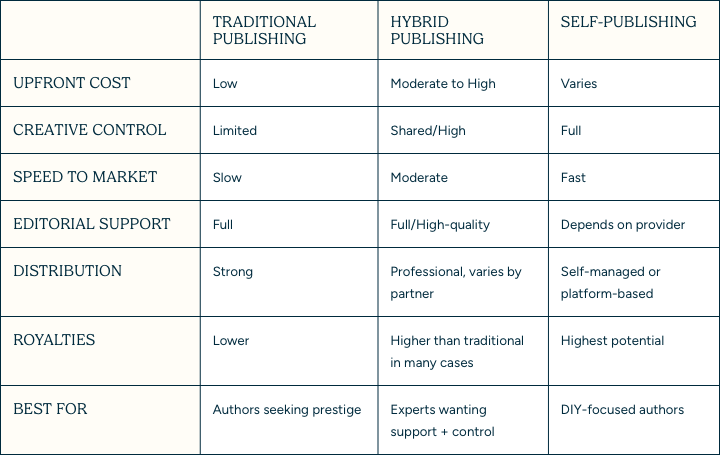
To make an informed decision about your book, it's important to understand how different publishing structures operate. Let's break down the key differences.
In a traditional publishing model, the publisher assumes the financial risk, pays you an advance, and takes control of the rights and creative direction. In self-publishing, you manage every detail, hire your own contractors, and keep all the profits.
Hybrid publishing sits precisely between these two paths. You invest your own capital upfront to fund the production of the book, paying for expert editing, cover design, formatting, and distribution. In exchange, the hybrid publisher brings an established team of professionals to execute the process at the highest level. They curate the talent, manage the project timeline, and ensure the final product meets traditional industry standards.
Hybrid Publishing vs. Traditional and Self-Publishing
Choosing the right publishing path requires matching the model to your specific professional objectives.
Traditional publishing offers high prestige and broad bookstore placement, but it demands patience and a willingness to surrender control. The process often takes two to three years from manuscript completion to publication. For a business leader trying to capitalize on current industry trends, this timeline is often too slow. (For a deeper understanding of how hybrid publishing compares to traditional publishing, be sure to read our article on Traditional vs. Hybrid Publishing.)
Self-publishing offers total freedom and immediate speed to market. You control every variable and keep every dollar of profit. However, it requires you to become a project manager, sourcing your own editors, designers, and formatters. If execution falls short, a poorly produced self-published book can harm the personal brand you spent years building.
Hybrid publishing provides the structure and quality of the traditional route with the speed and ownership of the self-publishing route. It is explicitly designed for professionals who have the resources to invest in their brand and the desire to publish a world-class book without compromising their strategic vision.
Pros and Cons for Authors
Publishing a book requires a clear understanding of what you stand to gain and what you must invest. For experienced industry professionals, hybrid publishing presents a distinct set of advantages and challenges.
The Advantages of Hybrid Publishing
Maintain creative control. You retain the final say over your cover design, your title, and your messaging. Your book remains an authentic extension of your personal brand.
Accelerate your timeline. You bypass the lengthy traditional acquisition process. A hybrid model allows your book to reach the market and start building your credibility within 12 months.
Keep higher royalties. You earn a significantly larger percentage of every sale compared to traditional contracts. This makes it easier to recoup your initial investment as your book gains traction.
Own your rights. You keep the intellectual property rights to your work. This allows you to adapt the content for speaking engagements, consultancy workshops, or future digital courses.
The Challenges to Consider
Assume financial investment. You pay for the editorial, design, and distribution services upfront. This requires a dedicated budget to bring your book to market.
Drive marketing efforts. You must actively promote your work to drive sales. While hybrid publishers provide distribution and marketing platforms, the author remains the primary engine for audience engagement.
Key Considerations When Choosing Hybrid Publishing
Not all hybrid publishers operate with the same standards. Because you are making a significant financial and professional investment, you must evaluate potential publishing partners rigorously. Consider these key factors:
Business Model: Understand the hybrid publisher's business model, including their fees, royalties and distribution policies. Ensure they are transparent about their processes and pricing.
Quality Control: Ask for samples of previous work to assess the production quality. Check for consistency and accuracy in editing, design, and formatting.
Author Input: Look for a publishing partner who values your input throughout the process. You should have final say on editorial decisions, cover design, and marketing strategies.
Distribution Reach: Research the publishing partner's distribution channels to ensure your book will reach your target audience effectively. Consider both print and digital platforms.
Reputation & References: Seek out references and testimonials from other industry professionals who have published with the partner. Make sure they have a good reputation in the publishing industry.
Author Support: Understand what level of support you will receive from the publishing team throughout the process. Will you have one-on-one consultations? Are there resources available for marketing and promotion? Ensure that the partner is invested in your success as an author.
Ultimately, selecting the right publishing partner is a crucial step toward achieving your goals as an author and industry leader. For more details on how hybrid publishing works and what to expect, visit our Hybrid Publishing FAQs.
How to Succeed in Hybrid Publishing
Publishing a book is not an isolated event; it is a strategic business asset. To maximize the impact of your hybrid publishing experience, you must align your book with your broader professional goals.
Start by strategizing your brand long before the publication date. Define exactly who your target audience is and what specific problem your insights will help them solve. Your book should serve as a bridge between your past accomplishments and the future opportunities you want to attract.
Next, build your audience actively. Use your active LinkedIn presence and your existing professional network to share behind-the-scenes updates about your writing process. Engage your audience early so they feel invested in your success by the time the book launches.
Finally, prepare to use the book to expand your influence. Send advanced copies to industry peers for positive reviews. Pitch yourself for industry conferences and speaking engagements, using the forthcoming book as proof of your authority. A published book dramatically increases your demand for consultancy services and executive advisory roles.
Elevating Your Authority Through Print
A well-written book elevates your authority, amplifies your ideas, and positions you in the rooms where decisions and opportunities are made. It turns your hard-earned industry experience into a tangible asset that works for you long after you leave the stage or finish the consultation.
Choosing the hybrid publishing path allows you to step into authorship with clarity and confidence. By partnering with experienced publishing professionals, you ensure your ideas are packaged with the respect and rigorous editorial standards they deserve.
You have done the work. You have built the expertise. Now, it is time to expand your influence and share your insights with the audience waiting to hear them. It's important to find a pattern who understands your vision.
Seek out a publishing partner who understands your goals, and begin the process of turning your knowledge into a lasting professional legacy.