
Hybrid Publishing vs. Traditional Publishing: Which Path Fits Your Book?
A book can do more than share ideas. For executives, consultants, founders, and subject-matter experts, it can build authority, sharpen positioning, open speaking doors, and support business growth. But before any of that happens, you need to choose a publishing path.
That decision is not always simple. When comparing hybrid publishing vs. traditional publishing, many professionals find themselves weighing credibility against control, speed against selectivity, and reach against ownership. Each model offers real advantages. Each also comes with tradeoffs that matter, especially if your book is part of a broader brand or thought leadership strategy.
This guide breaks down the key differences between hybrid and traditional publishing, including business model, editorial process, timeline, rights, royalties, distribution, and marketing expectations. If you are deciding how to bring a book to market, this article will help you evaluate both options with more clarity.
What Is Traditional Publishing?
Traditional publishing is the model most people know best. In this setup, a publishing house acquires the rights to your manuscript and invests its own resources into editing, production, distribution, and, in some cases, marketing.
Authors typically do not pay upfront for publishing services. Instead, the publisher takes on the financial risk and pays the author through an advance, royalties, or both. Because the publisher is investing capital, it is usually highly selective about which projects it accepts.
For many authors, traditional publishing carries strong market credibility. It can also offer access to established editorial teams, retail relationships, and industry infrastructure that may be difficult to build on your own.
What Is Hybrid Publishing?
Hybrid publishing sits between traditional publishing and self-publishing. In a hybrid model, the author usually makes an upfront financial investment to work with a professional publishing partner that provides services such as editorial development, design, production, distribution, and sometimes marketing support.
The exact structure varies by publisher. In many cases, authors keep more control over the project, maintain more rights, and receive higher royalties than they would under a traditional deal. In return, they help fund the publishing process.
For professionals using a book as a strategic asset, hybrid publishing can be appealing because it often combines expert support with greater speed and flexibility.
Hybrid Publishing vs. Traditional Publishing at a Glance
Here is the core difference: traditional publishers invest in the book and control more of the process, while hybrid publishers typically share the investment with the author and offer more collaboration and control.
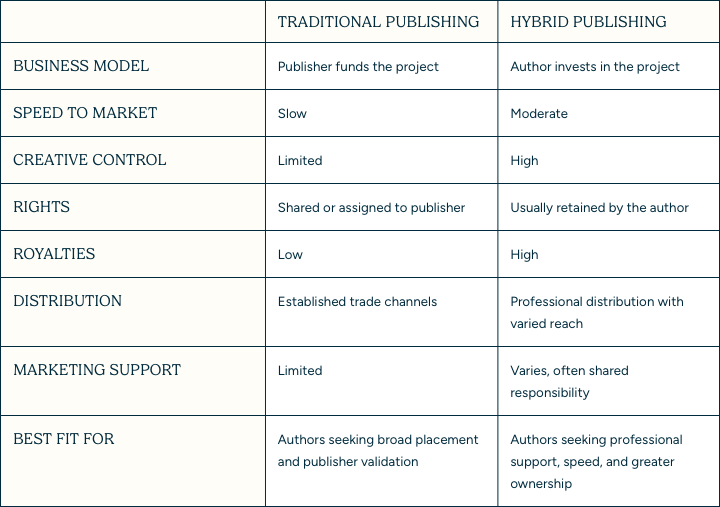
Business Model: Who Pays and Who Takes the Risk?
The business model shapes almost everything else.
Traditional Publishing: Publisher-Funded
In traditional publishing, the publisher absorbs the upfront cost of editing, design, printing, and distribution. Because of that investment, the publisher has strong financial and strategic control over what gets published and how the book is positioned.
This model can be attractive if you want external validation and do not want to finance the production process yourself. It can also reduce your direct financial risk.
The tradeoff is that publishers make decisions through a commercial lens. They are not only asking whether your ideas are strong. They are asking whether the book fits their list, can compete in the market, and justifies their investment.
Hybrid Publishing: Shared Investment
In hybrid publishing, the author pays for a defined set of professional services. That does not mean the model lacks rigor. A strong hybrid publisher should have standards, a clear process, transparent pricing, and quality controls.
For many experts and executives, this model makes sense because the book is not only expected to earn revenue through sales. It may also support consulting work, client acquisition, speaking, media exposure, or market positioning. In that context, the book functions as both a publication and a business asset.
The key question is not only cost. It is value. You need to know what services are included, what level of expertise you are getting, and how the publishing process supports your broader goals.
Editorial Support and Quality Control
Editorial quality matters in both models, but the process can feel different.
Traditional Publishing Editorial Process
Traditional publishers often have experienced editorial teams and established workflows. If your book is accepted, you may benefit from developmental editing, copyediting, design, and production oversight shaped by long-standing industry standards.
That said, editorial attention can vary widely depending on the publisher, imprint, and commercial priority of your book. Not every traditionally published author receives the same level of support.
Hybrid Publishing Editorial Process
Hybrid publishers usually position editorial quality as a core service. In the best cases, authors receive hands-on support from experienced editors, designers, and publishing professionals.
The advantage here is often access and collaboration. Because the model is service-based, authors may have more visibility into the process and more opportunity to shape the final product.
Still, quality is not guaranteed by the label alone. Some hybrid publishers deliver excellent work. Others do not. The burden is on the author to evaluate the team, review sample titles, and understand exactly what editorial support is included.
Speed to Market
For many professional authors, timeline is a major factor.
Traditional Publishing Is Usually Slower
A traditional publishing path often takes a long time. You may need to secure an agent, prepare a proposal, pitch publishers, negotiate a deal, complete revisions, and then wait for the publisher’s production schedule. In many cases, the process can take 18 to 36 months or longer from concept to release.
That timeline may be fine if your goal is broad trade distribution and you are willing to wait. But it can be a real limitation if your book is tied to a business launch, market opportunity, or speaking strategy.
Hybrid Publishing Is Usually Faster
Hybrid publishing is often more efficient. Without the same acquisitions bottlenecks and long in-house calendars, many hybrid publishers can move from manuscript to market on a much shorter timeline.
That speed can be especially valuable for leaders who want to publish while their ideas are timely, their platform is growing, or their business goals are immediate. A faster timeline does not always mean rushed. It can simply mean fewer gatekeeping layers and a more direct production path.
Creative Control and Decision-Making
Creative control is one of the clearest differences in the hybrid publishing vs. traditional publishing debate.
Traditional Publishing Offers Less Control
In traditional publishing, the publisher usually has significant influence over the title, cover, design, release date, pricing, and positioning. Authors may have input, but final decisions often rest with the publisher.
This can be a benefit if you want expert market guidance and are comfortable deferring to the publisher’s judgment. But it can also be frustrating if your book is closely tied to your brand, message, or business strategy.
Hybrid Publishing Usually Offers More Control
Hybrid publishing tends to give authors more say in major decisions. That can include editorial direction, design choices, messaging, launch timing, and brand alignment.
For executives, founders, and thought leaders, this often matters a great deal. If the book supports a larger platform, a higher degree of control can help ensure the final product reflects your voice and strategic goals.
More control, however, also means more responsibility. You may need to make more decisions and stay more involved throughout the process.
Rights and Ownership
Rights are one of the most important areas to review before signing any agreement.
Traditional Publishing Contracts
In a traditional deal, authors often grant the publisher rights to publish and exploit the work in specific formats, territories, or channels. The publisher may also control or share rights related to translation, audio, or subsidiary opportunities.
This is standard practice, but it means authors usually give up some degree of ownership and flexibility in exchange for the publisher’s investment and infrastructure.
Hybrid Publishing Contracts
Many hybrid publishers allow authors to retain more rights, sometimes including full ownership of the manuscript and intellectual property. That can be a major advantage for professionals who want long-term control over their ideas and brand assets.
Still, you should never assume rights ownership. Read the contract carefully.
Royalties and Revenue Potential
Money works differently under each model.
Traditional Publishing Royalties
Traditional authors may receive an advance against royalties, which can be appealing. But royalty percentages are often lower because the publisher has invested in the project and taken on financial risk.
For some authors, especially those focused on prestige and trade distribution, that tradeoff is acceptable. The value may come less from the royalty rate and more from market reach, brand signaling, or bookstore presence.
Hybrid Publishing Royalties
Hybrid authors often receive a higher share of net revenue or royalties because they have contributed financially to the project. If the book sells well, that can create stronger long-term upside.
At the same time, there is usually no advance, and the author has already made an upfront investment. This model often makes the most sense when the book’s return is expected to come from a mix of sales, authority, lead generation, and business impact.
Distribution: Availability vs. Reach
Distribution is an area where many authors make assumptions, so clarity matters.
Traditional Publishing Distribution
Traditional publishers often have well-established relationships with distributors, retailers, wholesalers, and media channels. That infrastructure can improve the odds of broader placement and visibility, especially in trade markets.
Still, even traditional publishing does not guarantee bookstore placement, strong sell-through, or major promotional support. A book can be traditionally published and still receive only modest backing.
Hybrid Publishing Distribution
Hybrid publishers may offer professional distribution through recognized channels, making the book available through major online retailers and, in some cases, broader wholesale networks.
That is valuable, but availability is not the same as demand. Authors should ask practical questions:
Where will the book be sold?
In what formats?
Through which distribution partners?
Is there support for print and ebook?
What does the publisher do to support visibility?
A credible hybrid publisher should answer these questions in plain language.
Marketing Expectations: No One Does It All for You
This is where many authors need a reality check.
Traditional Publishing Marketing
A common myth is that traditional publishers handle all marketing. In reality, only a small number of authors receive major promotional support. Much depends on the book’s commercial potential, the author’s platform, and the publisher’s priorities.
Even traditionally published authors are often expected to build visibility through speaking, media, social content, email, partnerships, and personal outreach.
Hybrid Publishing Marketing
In hybrid publishing, marketing support varies widely. Some publishers offer launch planning, positioning, PR support, or campaign guidance. Others focus mainly on production and distribution.
In most cases, hybrid authors should expect shared responsibility. If you already have a business audience, client base, podcast presence, speaking platform, or professional network, that can work in your favor. You are not starting from zero.
For experts and executives, this is often the right mindset: your publisher supports the book, but you remain central to the platform and message.
Ideal Author Fit: Who Should Choose Which Path?
The best model depends on your goals, timeline, resources, and tolerance for tradeoffs.
Traditional Publishing May Be a Better Fit If You Want:
Strong external validation from a recognized publisher
Broad trade market ambitions
A chance at bookstore distribution through established channels
Lower upfront financial commitment
A publisher-led process, even with less control
Traditional publishing can be a strong path if your main goal is market prestige, broad consumer reach, or institutional credibility through an established imprint.
Hybrid Publishing May Be a Better Fit If You Want:
A faster route to publication
More creative and strategic control
Greater ownership of rights and assets
A professionally produced book aligned with your brand
A publishing model that supports business, authority, or thought leadership goals
Hybrid publishing can be especially effective for professionals who see the book as part of a broader strategy, not just a standalone retail product.
The Bottom Line on Hybrid Publishing vs. Traditional Publishing
There is no single best publishing path for every author. The right choice depends on what you value most.
Traditional publishing offers selectivity, established infrastructure, and strong market signaling. It can be a smart fit for authors who want publisher validation, are willing to move more slowly, and are comfortable giving up some control in exchange for reach and support.
Hybrid publishing offers speed, flexibility, collaboration, and often greater ownership. It can be a strong fit for industry leaders, experts, and executives who want a high-quality book that supports a larger business or brand strategy.
The smartest decision is the one that matches your goals, not the one that sounds most impressive on paper. If your book is meant to build authority, shape perception, and create long-term value, choose the model that best supports that mission from start to finish.